





Holiday Let Welcome Pack Template: What to Include for Guests
One of the easiest and most effective ways to welcome guests to your property, and help them to settle...


According to the UK government domestic homes account for around 13% of the UK greenhouse gas emissions. In an aim to reduce the impact we have on the planet and contribute to a sustainable future, it is a legal requirement for a property (for sale or sold) to have an Energy Performance Certificate (EPC), in order to clearly identify the energy efficiency and carbon emissions of a property.
Read on to learn more about holiday let EPCs, or if you’d like to learn more about holiday letting, complete the form at the bottom of this page to request a free Owner Guide.
Learn everything you need to know about Energy Performance Certificates for holiday lets, your legal obligation and how to promote greener energy consumption in your home in this helpful guide. If you’d like to find out about a particular topic, use the quick links below:
An Energy Performance Certificate (EPC) is a document that is produced following a report on the energy efficiency and carbon emissions of a property. The certificate provided clearly highlights an overview of the energy performance of a property in a colour-coded band system; band ‘A’ being the most efficient and band ‘G’ being the least.
The intention of an Energy Performance Certificate is to inform home owners and potential buyers of the following:
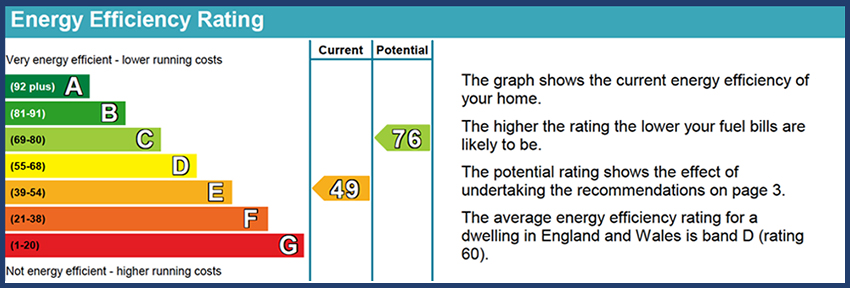
* Example from Energy Performance Certificate (EPC) – Gov.uk
In order to calculate the energy efficiency band of a property, a qualified EPC assessor will need to determine a number of elements to better understand how energy is used in the home. These include the following:
Each segment of an inspection will be given a score depending on how efficient it is and what condition it is in. The assessor will then calculate how energy efficient the property is and will provide an EPC rating.

The assessment will be based on examining four key factors:
Once the entire property has been surveyed, the EPC band will be calculated. This provides a rating and also provides useful information on what can be changed in your property to further improve your EPC rating and help in the fight against climate change.
According to government guidance, an EPC is a legal requirement when a property is sold, rented or built, meaning an EPC is normally required.
However, the government website does state EPCs are not required for holiday accommodation that’s rented out for less than 4 months a year. So, for holiday home owners with limited weeks available to let, there may not be a need.
Because the government guidance includes exemptions and can vary by case, it’s strongly advised that owners consult the government’s up to date information on Energy Performance Certificates for the marketing, sale and let of dwellings, and contact their local authority or Trading Standards office for clarification.
Yes, you will need an Energy Performance Certificate for your holiday let if you decide to sell it. By law, you must provide an EPC free of charge to the prospective buyer.
If your holiday home has been built, purchased or rented out at any point over the past 10 years, then there should be a record of your holiday home’s Energy Performance Certificate on the national EPC register. All EPCs remain on the register for 20 years, so you can find multiple EPCs for the same property, including expired ones. Enter your postcode and you should be able to find your property, the EPC and any energy performance recommendations.
Yes. As of 2026, listed buildings no longer qualify for an exemption and must obtain an EPC when marketed or let. Previously, since January 2013, listed buildings that would require potentially character-changing alterations to meet minimum energy performance requirements could be exempt from the certificate. However, this exemption has now been removed. That said, EPC recommendations will take into account the heritage characteristics of your building, and exemptions for specific unsuitable measures remain available. You should get advice from your local conservation authority as to which energy improvements are appropriate for your building’s structure.
An EPC must be produced following an energy assessment undertaken by an accredited energy assessor. The inspection takes approximately 1-2 hours, and the cost typically ranges from £60 to £120, but may be higher for larger or older properties. Click here to find a qualified EPC assessor.
An EPC certificate is valid for 10 years and can be reused as many times as needed within that period. A new certificate is not required each time there is a change of tenancy or the property is sold, provided it is no more than 10 years old.
Whether or not it is legally required to have an EPC rating of your existing holiday let, the benefits of having one are clear.
Having an EPC report for your holiday let is likely to provide you with ideas of how you can make your property more energy efficient and potentially lower your energy bills.

* Example from Energy Performance Certificate (EPC) – Gov.uk
According to the latest ONS data (2025), the median Energy Performance Certificate rating is Band C in England (score 69) and Band D in Wales (score 68). By making the recommended changes identified on the EPC, you could reduce your property’s CO2 emissions by a significant amount each year. Switching to renewable energy sources is a fantastic way to reduce emissions and help to protect the environment at the same time, by lowering the negative impact of your property.

Improving energy efficiency will not only contribute to a sustainable future and save you money, but can add to the marketability of your holiday let. According to the VisitBritain Domestic Sentiment Tracker 2025, one in four (25%) UK adults said that climate change influences their holiday choices to a large or very large extent, with younger adults more likely to be influenced. Indeed, 32% of UK adults claimed to have specifically looked for sustainable holiday accommodation. Adding renewable electricity options opens you to a larger market, and makes your property stand out from the crowd.
If you are interested in other ways to make your property more sustainable, read our guide on Electric Charging Point Installation.
There are a number of ways that you can improve the energy efficiency of your holiday let, reducing its environmental impact. As part of the EPC assessment, you’ll be provided with recommended measures specific to your home. You’ll also be given an indicative cost of what the improvements might cost, as well as what the changes could help you save in value.
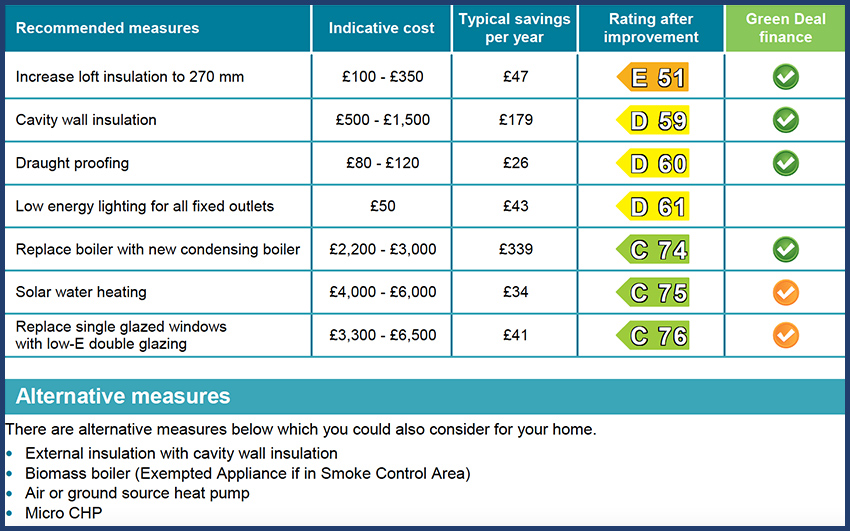
* Example from Energy Performance Certificate (EPC) – Gov.uk
Recommendations from your EPC could include:
Find out more about improving your holiday home’s energy performance in our blog on how to make your holiday home eco-friendlier and more sustainable. You can also use the Energy Efficiency Calculator for personalised advice on how to cut your energy bills, and to find energy grants available for your home.
If you would like more advice on how to start a holiday let business, whether a holiday let is a good investment or what the holiday let rules and regulations are, complete the form below. Our team will be in touch to answer any questions and provide a copy of our free Owner Guide.

Interested in letting a property outside of South Devon? We’re proud to be part of Sykes Holiday Cottages, with a network of regional brands offering the same award-winning service across the UK. Enquire now to be put in touch with your local holiday letting experts.

Find out how we can work together. With over 25 years’ experience, our local expertise will give you peace of mind and bring you the bookings you deserve.

I’ve had the privilege of living in the beautiful South West since 2010, and in my opinion there’s no better place in the worl...
Read More About Author
Sign up to receive exclusive offers, competitions and the latest news to your inbox, and you'll be entered into our monthly prize-draw 3 times!

One of the easiest and most effective ways to welcome guests to your property, and help them to settle...

All self-catering holiday homes in the UK are subject to specific holiday let rules and regulations. As an owner,...

For farmers across the country, times are challenging – but the resourcefulness of people in the industry means many...

